
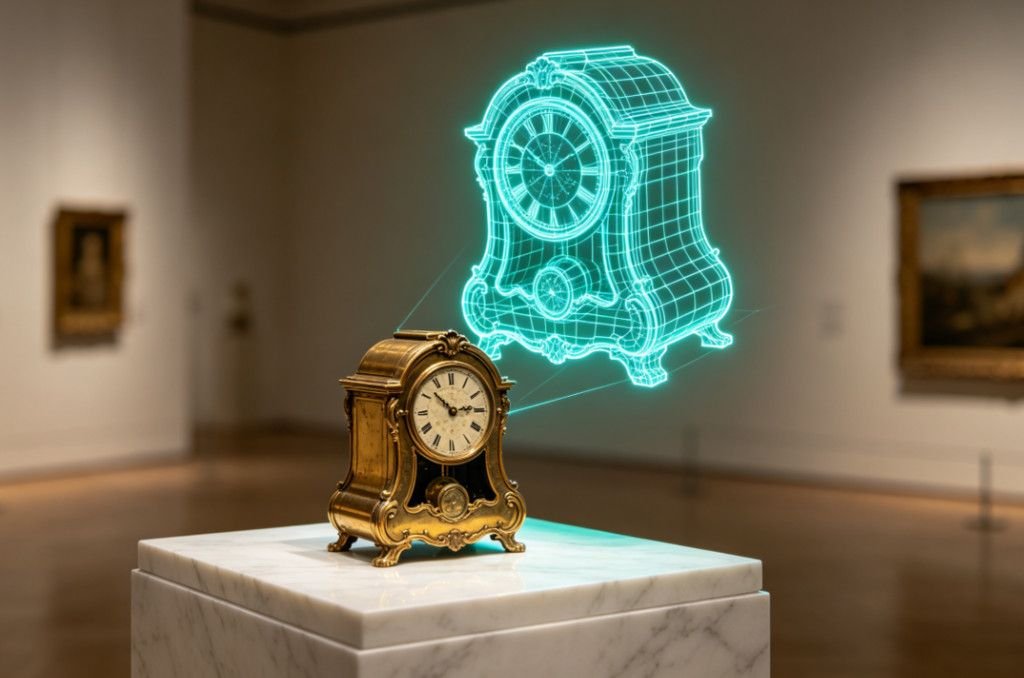
There is a quiet tragedy in the physical world: objects decay. A porcelain figurine chips, a leather-bound diary fades, and the personal artifacts that define our history eventually succumb to time. In the past, photography was our only shield against this loss, but a photograph is a flat ghost. To truly preserve the essence of an object, we need to capture its volume, its weight, and its mathematical truth. This is where the image to 3D AI tool shifts from a utility to a medium of preservation, allowing us to immortalize physical specimens as precise digital entities.
The limitations of traditional archiving:
🔹 Photographs lack the spatial context required for true reconstruction.
🔹 Manual 3D modeling of complex, organic artifacts takes weeks of artisanal labor.
🔹 Standard “photogrammetry” often results in “triangle soup”—unoptimized, broken meshes that fail to reflect the original form.
From Fragment to Form: The Logic of Direct3D-S2
True preservation requires more than surface-level guessing. Neural4D utilizes the Direct3D-S2 architecture to perceive objects through native volumetric logic. Instead of stitching together pixels, the system employs Spatial Sparse Attention (SSA) to understand the inherent structure of the object. This results in a reconstruction at a native 2048³ resolution, ensuring that every subtle curve and structural detail is recorded with high fidelity.
The objective is to create a digital fossil that is as functional as it is accurate. For those looking to bridge the gap between a static image and a portable digital asset, understanding how to convert an image to GLB is the essential first step in building a modern digital archive.
The Ethics of Digital Purity: Clean Topology
In the realm of archiving, the “skeleton” of the digital model matters as much as the skin. Neural4D ensures that the output is a quad-dominant mesh, the digital equivalent of a well-organized specimen. This clean structure allows the object to react to light naturally within a PBR workflow, capturing the specific albedo and material properties of the original item.
Neural4D-2.5 Archival Standards:
✅ Generation of watertight geometry, ensuring the digital specimen is a complete, closed volume.
✅ Zero non-manifold edges, making the model immediately ready for physical restoration via 3D printing.
✅ Native support for high-precision normal and roughness maps to preserve surface tactility.
Reclaiming the Tangible
By creating a “watertight” digital archive, we are not just saving a visual; we are saving a blueprint. These specimens can be scaled, studied, or even 3D printed to return to the physical world. We are no longer just capturing a moment in time through a lens. We are building a library of the tangible world, one mathematically perfect mesh at a time.