
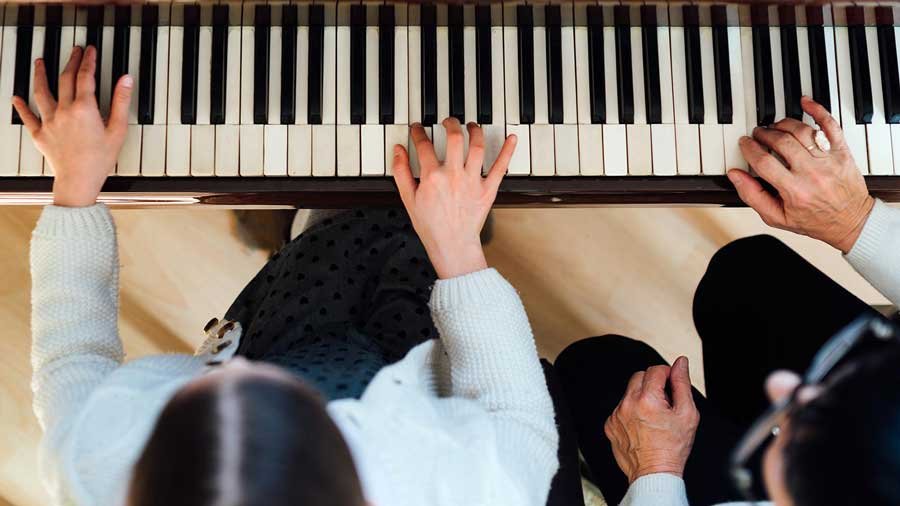
Are you planning to take your passion for music to the next level by indulging in music lessons? Are you afraid that your “passion” won’t be enough to help you become a successful musician?
Well, (a) don’t overthink it because (b) we have your back.
There’s no denying that music is humankind’s universal lingo.
It is no surprise that many famous singers use music to express their life, feelings, and experiences (yes, we’re talking to you, Taylor Swift. There’s nothing wrong with that – we enjoy expressing ourselves through music.
It is extraordinary to learn an instrument for the first time or try something new in music as a seasoned musician. However, enthusiasm alone will not ensure the success of your music lessons.
Whether you’re just starting on the drums or are a knowledgeable musician, a mixture of hard work and the ability to focus on the right things will help you achieve your goals.
So if you’re new to music lessons, these pointers will help you get started:
- Set realistic goals and work toward them.
Setting attainable goals is the best way to accomplish a progressive activity like music learning.
After all, when you sign up for music classes and lessons, you don’t just work on your skills when you are in class. You have to practice as it can mean the difference between feeling stuck and making progress.
So set aside time each week (an hour three times a week, 20 minutes per day, etc.) for learning and practicing. Maintain your focus. However, don’t be afraid to be adaptable.
Moreover, you can schedule a session during your downtime or shift your regular session to a different time of day.
- Of course, you must select an instrument.
This is a fairly straightforward step. However, selecting the right instrument for you entails balancing your time constraints (realistic) and what your heart truly desires (dream big).
If the rhythm section of a song is your favorite part, you should learn to play the drums. However, suppose you only have a limited amount of time to devote to it. You might want to start with a more accessible instrument, such as the ukulele.
- Select the best teacher
If your music teacher cannot explain why they want to teach you something you dislike, you should consider whether that teacher is right for you. They most likely aren’t.
If your personality does not sync up with theirs, do not be afraid to seek out another teacher. It can be especially beneficial when first taking lessons from various teachers to determine who you love learning from the most.
After all, each teacher’s methodology and style will be unique. However, if you know what you want to achieve, you can pick the ideal teacher to help you get there.
- Learn about music theory and history.
Studying music history and theory can help round out your musicality and reframe the pieces you’re learning.
Music theory will help you make sense of the chords and melodies in your piece, making it much easier to learn. As you learn more elements, you may notice similar characteristics in musical structures.
Music history can show you how musical philosophies have changed and help you understand pieces from different eras.
- Attend lessons in a professional teaching setting
It is not enough to have a qualified teacher to study music; it is also necessary to have a music-focused environment.
A professional school environment can produce better results with only 12 to one hour of lesson time per week because the only focus is learning music.
Students in a school setting are also motivated by hearing peers of varying levels and being exposed to various musical instruments.
Lessons in a music school are more than just a hobby or a side job for the teachers; they are a career.
- Choose your favorite songs.
Of course, you should always start with songs appropriate for newbies. Still, a good tip is to skip the generic suggested songs and instead look for artists you like and search for their most straightforward tracks to learn.
For example, if the Black Keys are your favorite band and you’re learning guitar, you might try their song Lonely Boy, which rotates between three similar chords: E, A, and G.
Moreover, you will learn more quickly if you are engaged in material that you enjoy and that makes you feel happy.
- Purchase music accessories.
Guitar strings, stands, reeds, straps, and rosin are available. As an aspiring musician, you’ll need accessories to participate in your music lessons.
Simply put, you have your instrument, but your bass guitar, trombone, or clarinet won’t get you far in music. Accessories, such as guitar strings on a guitar, are required to make your instrument playable.
Then there are the musical accessories that all musicians require, such as metronomes, straps, and music strands.
One of the easiest ways to set yourself up for success in music lessons is to arrive prepared with all of the necessary equipment.
- Take notice of your teacher’s suggestions.
Give it a shot if your teacher says you should learn something new. Don’t ignore a suggestion simply because you don’t like the piece or song.
There’s probably a reason why your teacher chose it. Perhaps it is analogous to a skill you must master to achieve your objectives. The best approach is trust.
You can also always ask them why they told you to do it, and they will almost certainly have an answer.
- Keep track of your practice sessions and lessons.
Keeping a portable audio recorder prepared and ready to record is a good idea no matter what you’re learning in classes or how much experience you have.
Make a habit of recording yourself while practicing at home and during classes. We have the invaluable ability to make critiques and enhance when we can hear what we sound like while playing our instruments.
Capturing instructions from your teacher or examples of them playing their instrument during lessons is also a significant asset.
The habit of recording your classes and practicing sessions will not fade away after a few months. Still, it can and should be maintained for as long as you pursue music.
- Have fun!
The critical point to remember when learning a new skill is to have fun with it.
Don’t be afraid to experiment with your music. Put your heart and soul into your music, and one day you’ll be able to play in ways you never imagined possible.
Conclusion
So these are some of the tips that will help you get started with your music lessons.
Music is a fun activity, but apart from that, it has a wide range of benefits, including improving your mood and taking away all the bad energy.
So follow your passion and mix it with consistency and discipline. With some help, you can discover your instrument, voice, activity, and maybe your new calling.